
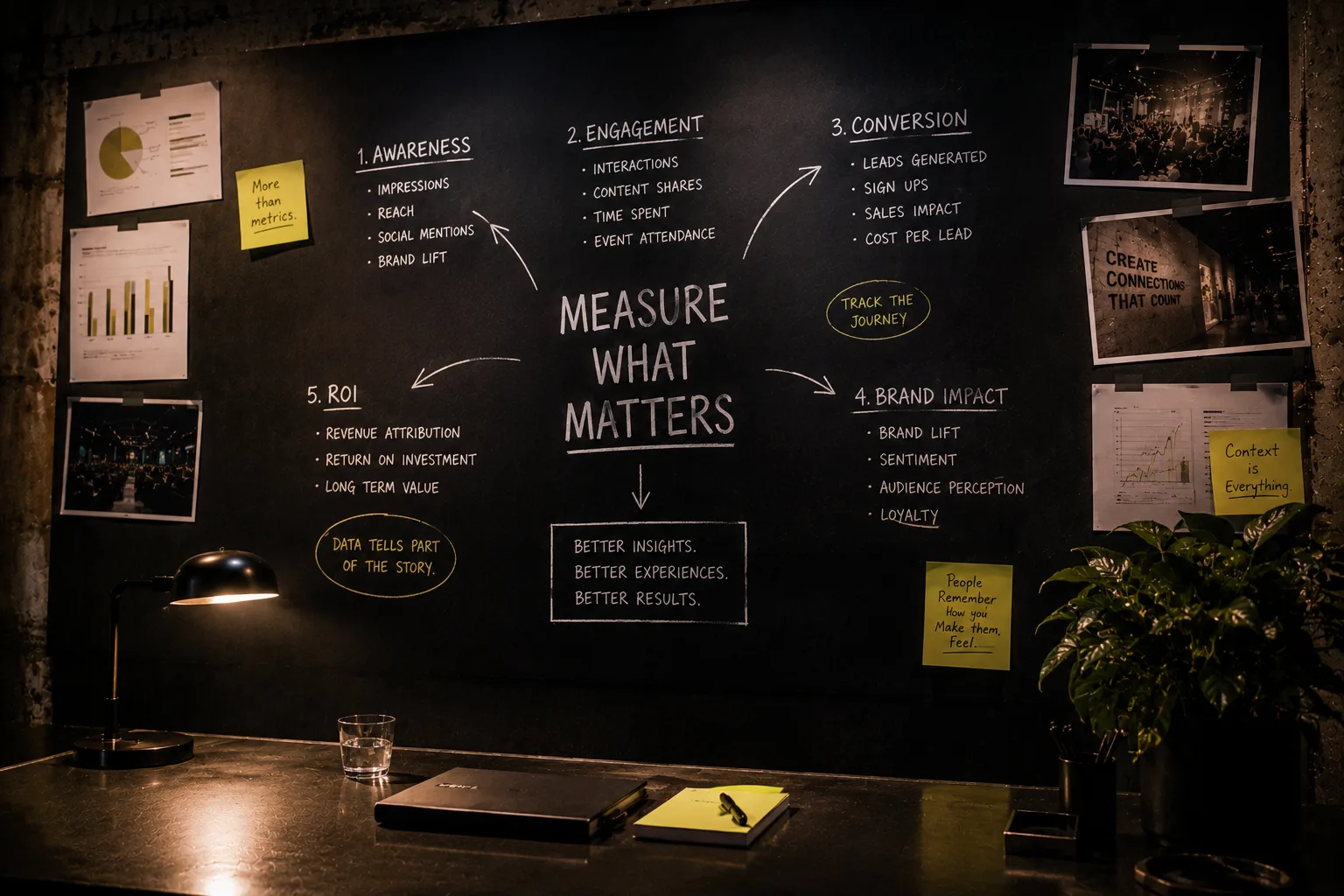
ROI is the toughest question in experiential marketing. Brand teams know that live experiences create memorable moments, but proving their business value is another story. In an era of shrinking budgets and higher expectations, being able to measure ROI on experiential marketing campaigns is essential for justifying investment and guiding future strategy.
Unlike digital spend, experiential metrics are rarely plug-and-play. But with the right framework, you can connect the dots between experience and outcome, and build a clearer case for your next activation, whether you’re launching in East London or taking over UNLOCKED Wynwood’s 50,000 square feet in Miami.
Start with Clear Campaign Objectives
ROI starts before your event. The most common mistake is setting vague goals. If you want to prove the value of your experiential campaign, get specific. Are you looking to drive sales, grow your CRM, shift brand perception, or create branded content that travels?
- Define one or two primary goals. Examples: Email sign-ups, direct sales, social reach, or NPS improvement.
- Align stakeholders on what success looks like. Document this ahead of creative development.
- Build your KPI list early. Your venue, tech, and team choices can then feed those needs.
At purpose-built spaces like UNLOCKED, you can plan for data capture zones or interactive touchpoints from day one, making measurement seamless.
Choose the Right KPIs for Experiential ROI
Traditional event metrics (attendance, dwell time, exit surveys) are only part of the story. Map KPIs to both your objectives and the real strengths of live experiences.
- Engagement Metrics: Number of interactions, participation rates, session duration at specific activations.
- Data Collection: New leads, opt-ins, QR scan rates, newsletter sign-ups.
- Brand Sentiment: Pre/post surveys, social listening for campaign hashtags, qualitative feedback.
- Sales Impact: On-site purchases, discount code usage, attributed lift in local sales.
- Content & Reach: Earned media mentions, UGC volume, influencer amplification.
Leverage Technology for Tracking
Modern venues are tech-enabled. Use this to your advantage. Integrate digital check-ins, RFID wristbands, or QR-triggered experiences to track movement and engagement throughout the space. At a large-scale venue like UNLOCKED Wynwood, digital mapping can provide insights on guest flow and hot spots, pairing physical activation data with digital outcomes.
Consider:
- Apps or dedicated event platforms for registration and post-event follow-up
- Heat mapping tools to analyse which activations command attention
- Content capture points to quantify UGC and real-time social engagement
Data privacy is critical, make opt-in clear and secure, and work with partners who uphold GDPR best practice.
Connect Experience Data to Business Results
Quantitative metrics matter, but ROI is strongest when you can link experiential touchpoints to bottom-line shifts. The challenge is attributing outcomes to in-person events when customers might purchase or share days later.
- Use unique promo codes or UTM links tied to your campaign.
- Track follow-up engagement: sign-ups at the event that convert to digital engagement or sales down the line.
- Monitor brand perception shifts using before-and-after surveys for attendees and digital audiences.
For campaigns staged in flexible venues like UNLOCKED Shoreditch, you can design feedback loops, from on-site surveys to digital follow-ups, to capture both immediate and long-tail impact.
Don’t Ignore Qualitative Insights
Some of your most powerful ROI signals won’t fit a spreadsheet. Client testimonials, influencer reactions, and unprompted guest feedback can reveal the emotional and reputational impact of your experience. Record interviews, monitor organic social posts, and gather press mentions for a fuller picture.
Combine these stories with your quantitative data when reporting back to stakeholders. The strongest case for experiential ROI blends the measurable with the memorable.
Iterate and Improve with Every Campaign
No two activations are the same, but every campaign is an opportunity to refine how you measure, report, and grow. Build a post-campaign review process that looks at what worked, what can be improved in your data capture, and how venue choices influenced outcomes.
Venues that are adaptable and tech-ready make it easier to evolve your approach, whether you’re staging a single night takeover in London or a multi-day experience in Miami.
Conclusion: ROI Measurement Is Essential for Experiential Marketing Success
Measuring ROI on experiential marketing campaigns is no longer a luxury. It is a must-have skill for marketing managers and brand teams looking to prove the value of their activations. With clear objectives, tailored KPIs, the right tech, and a process for connecting experience to business outcomes, you can unlock the true power of live events, whether at a raw blank-canvas space or a custom-built venue. The future of experiential marketing belongs to those who can measure what matters.